Equipment
Why a Coffee Scale Improves Every Cup
A coffee scale lets you brew by weight instead of scoops, so you get the same ratio every time. Here's what to look for and how to use one.
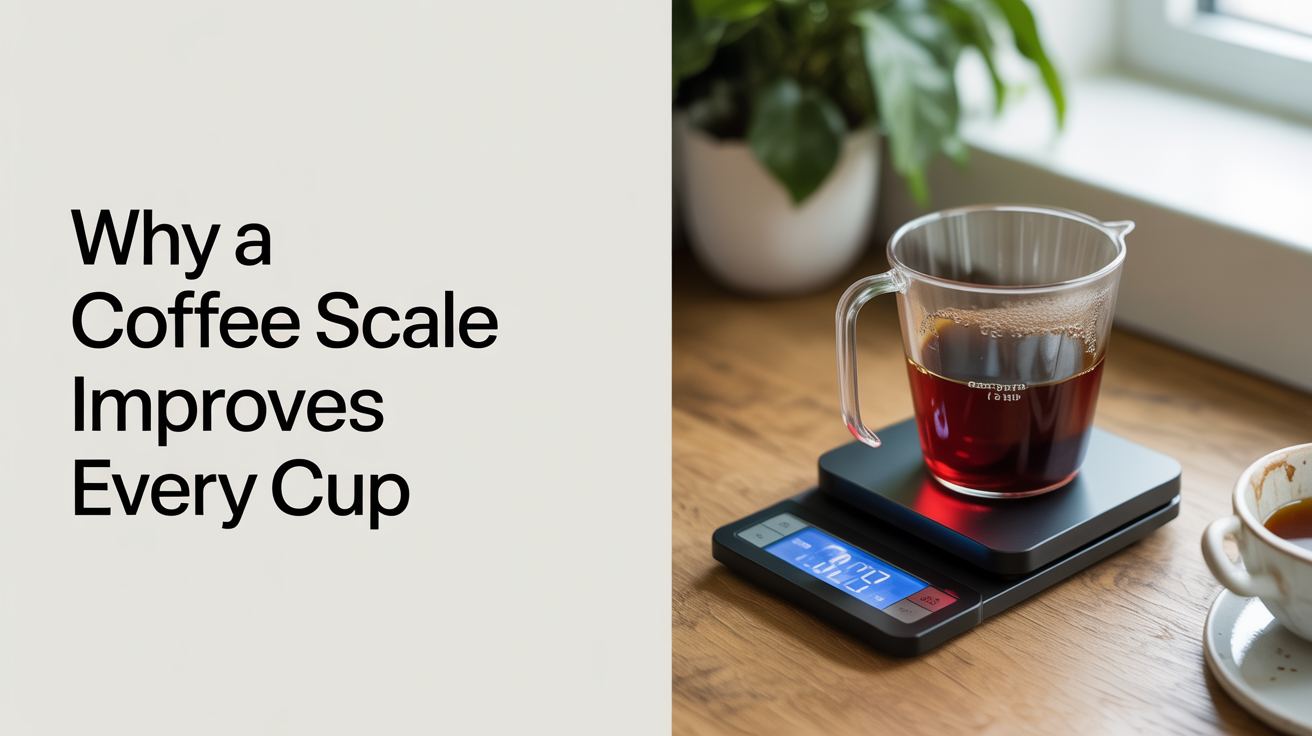
A coffee scale removes the biggest variable most home brewers never think about: the scoop. A heaping tablespoon of coarsely ground coffee and a heaping tablespoon of finely ground coffee are not the same dose. They're not even close. A scale gives you a number instead of a guess, and that number is what makes your good cups repeatable.
This is also one of the cheaper upgrades you can make. A decent coffee scale costs $20 to $50. It will have a bigger effect on cup quality than most things priced above it.
Why Scoops Fail You
The volume of ground coffee changes depending on roast level, grind size, and how settled the grounds are in the bag. A dark roast ground fine for espresso packs a tablespoon differently than a light roast ground coarse for pour-over. Both weigh differently. If you're chasing a consistent cup, scoops just can't get you there.
Weight doesn't have that problem. 18 grams is 18 grams regardless of roast, grind, or how long the bag sat open. Once you find a ratio you like, it reproduces exactly.
The standard starting point for most filter methods is 1:16, meaning 1 gram of coffee to every 16 grams of water. For a 300 ml cup, that's roughly 18.75 g of coffee and 300 g of water. You can dial from there, but you now have a baseline that means something.
What to Look For in a Coffee Scale
Not all kitchen scales work well for coffee. The differences matter once you're actually brewing.
Resolution: 0.1 g matters for espresso
Most kitchen scales read to the nearest gram. That's fine for pour-over and French press, where your dose is 15 to 30 grams and a 1 g error is small. For espresso, where a 17 g dose is the target and 0.5 g off changes the shot, you want 0.1 g resolution. Look for this on the spec sheet before buying.
A built-in timer
You don't need a separate timer if the scale has one. Pour-over brewers track total brew time; espresso brewers track shot time. A scale that displays both weight and elapsed time on the same screen is easier to use with wet hands than a phone timer.
Response speed (and why slow scales annoy you)
Some budget scales update their display every half-second or more. When you're pouring water and watching the number climb, that lag means you consistently overshoot. Look for a scale that updates at least 10 times per second. Manufacturers sometimes list this as "sampling rate" or "response speed." If the product listing doesn't mention it, the scale is probably slow.
Auto-tare and capacity
Most coffee scales have an auto-tare button. Press it with a vessel on the scale and it zeroes out. This is not a premium feature; it's standard. Capacity matters too. A kitchen scale rated to 5 kg is fine for coffee. Some specialty scales cap at 2 kg, which is also plenty. Where scales diverge is in their minimum weight accuracy. Some are accurate at 1 g but not below; check the specs if you're weighing single-dose espresso shots.
How to Brew Pour-Over by Weight
The workflow is simple and becomes automatic within a week.
- Place your brewer and empty vessel on the scale. Tare to zero.
- Add ground coffee directly to the filter. Note the weight (or tare again).
- Start the timer when you begin your first pour.
- Pour water to your target weight in stages if your recipe calls for it (a bloom pour, then two or three larger pours).
- Stop when you hit your total water weight.
For a 1:16 ratio using 22 g of coffee, you're aiming for 352 g of water. Most people round to 350. The difference between 350 and 352 is not something your palate will detect. The difference between 350 and 400 definitely is.
If you're also using a gooseneck kettle, you'll find it much easier to control a slow pour onto the scale, since the narrow spout lets you slow down before you overshoot your target weight.
How to Dial In Espresso by Weight
Espresso is where a scale earns its price. The variables are tighter and the consequences of being off are more noticeable.
A common starting ratio for espresso is 1:2, meaning a 18 g dose yields 36 g of liquid in the cup. This isn't universal; some light roast espressos taste better at 1:2.5 or 1:3. But you can only know where you are if you're measuring both sides.
Weigh your dose before grinding. Weigh your yield after pulling. If you're getting 45 g out of an 18 g dose when you want 36, you know to stop the shot sooner. Without the scale, you're guessing from color and timing alone.
The practical difference between cheap and more expensive espresso scales is usually response speed and how flat they sit under a portafilter. Some budget scales have lips or raised edges that make them awkward to place under the group head. Measure the clearance on your machine before buying.
A Quick Comparison: Scale Features at Different Price Points
| Feature | Budget ($15-25) | Mid-range ($30-55) | Specialty ($60+) |
|---|---|---|---|
| Resolution | 1 g | 0.1 g | 0.1 g |
| Timer | Sometimes | Usually | Yes |
| Response speed | Slow (0.5-1 s) | Medium (0.2-0.5 s) | Fast (under 0.1 s) |
| Waterproofing | None | Splash-resistant | Often full |
| Display | Basic | Backlit | Backlit + large |
Budget scales work fine for pour-over if you don't mind slow response. For espresso, the 0.1 g resolution and faster response of a mid-range scale make a real difference. Specialty scales are built for precision above all else, and you pay for it.
Pairing Your Scale with the Rest of Your Setup
A scale is most useful when the rest of your setup is also reasonably consistent. If you're using a blade grinder that produces a different grind distribution every time, you'll brew consistent doses of inconsistent grounds. The scale can't fix that.
The more impactful gear upgrade, before or alongside a scale, is usually a burr grinder. Once your grind is consistent, weighing your dose means every brew starts from the same place. If you're already using a burr grinder and weighing doses but still getting inconsistent results, the next variable to check is how you're grinding, not just what you're weighing.
That said, even with a blade grinder, switching from scoops to weight will produce more consistent results than not measuring at all. Progress is progress.
Frequently Asked Questions
Do I really need a coffee scale, or is it overkill for home brewing?
You don't need one. Plenty of people brew decent coffee by scoops for years. But if you've ever made a cup that tasted great and then couldn't replicate it, the dose is often why. A scale solves that. It's not overkill; it's the cheapest precision upgrade available.
What's a good coffee-to-water ratio to start with?
For filter coffee (pour-over, drip, French press), 1:16 is a reasonable starting point. That's 1 gram of coffee per 16 grams of water. A 20 g dose brews about 320 ml. From there, use more coffee if you want stronger, less if you want lighter, and adjust in 1-2 g increments until you find your preference.
Can I use a regular kitchen scale for coffee?
Yes, with caveats. A kitchen scale that reads to 1 gram works fine for pour-over. It probably won't work for espresso, where 0.1 g resolution matters. Response speed is the other limitation: a kitchen scale that updates every second makes it hard to pour accurately. If it's what you have, use it. If you're buying something specifically for coffee, spend the extra $15 for 0.1 g resolution.
How do I tare for pour-over without lifting the dripper mid-brew?
Put your brewer, filter, and empty vessel all on the scale together. Tare to zero. Add your ground coffee. Note the weight, then tare again before pouring. You can now pour directly and watch your water weight climb without moving anything. Some brewers prefer to keep the coffee weight visible and add it mentally to their water target, but taring again is simpler.
Does water temperature affect what I should measure?
Temperature affects extraction but doesn't change how you measure. You still weigh water in grams regardless of temperature. The temperature question is separate: most filter coffee brews well between 90 and 96°C (194-205°F), with lighter roasts benefiting from water closer to boiling. Measure weight with your scale, dial temperature with your kettle.