Equipment
Do You Really Need a Gooseneck Kettle
Honest guide to gooseneck kettles: who actually needs one, where a regular kettle works fine, and what to look for if you buy.
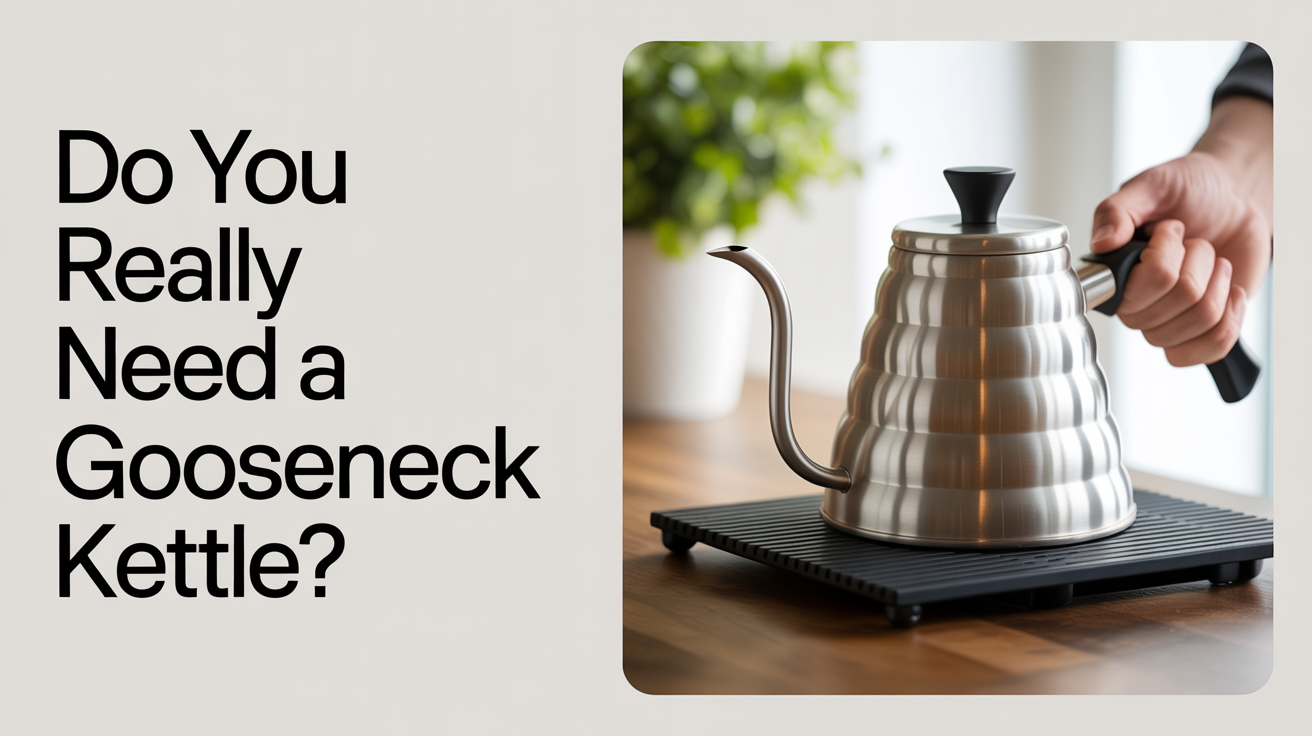
For pour-over brewing, yes, a gooseneck kettle makes a real difference. For everything else, it's mostly preference. The long, curved spout slows the water to a thin, controllable stream, which matters a lot when you're doing a Chemex bloom or a V60 spiral. If you brew French press or drip coffee, a standard kettle works fine.
Here's what the purchase actually depends on.
What a gooseneck spout actually does
A regular kettle pours fast and wide. Tilt it and water rushes out in a torrent. That's fine for filling a pot or making tea, but pour-over brewing asks for something different.
The gooseneck neck restricts flow to a narrow column, usually 3–8mm wide depending on the kettle. That lets you pour at roughly 5–8 grams per second with a steady wrist, rather than the 15–25 g/s you'd get from a standard spout. It also gives you directional control: you can place water precisely on the grounds instead of guessing.
Two things happen when you nail the pour:
- Even saturation. The bloom phase (that 30–45 second rest at the start) needs every ground particle to get wet, the even-saturation step the National Coffee Association's pour-over guide centers on. A wide pour misses spots, leaving dry pockets that produce unextracted, sour notes.
- Stable bed agitation. After the bloom, you want to move the grounds gently, not blast them. A hard pour from a standard kettle churns the bed and forces fine particles against the filter, which chokes the draw-down.
None of this is mystical. It's just physics. Slow water goes where you aim it; fast water goes where it wants.
Where it matters vs. where it doesn't
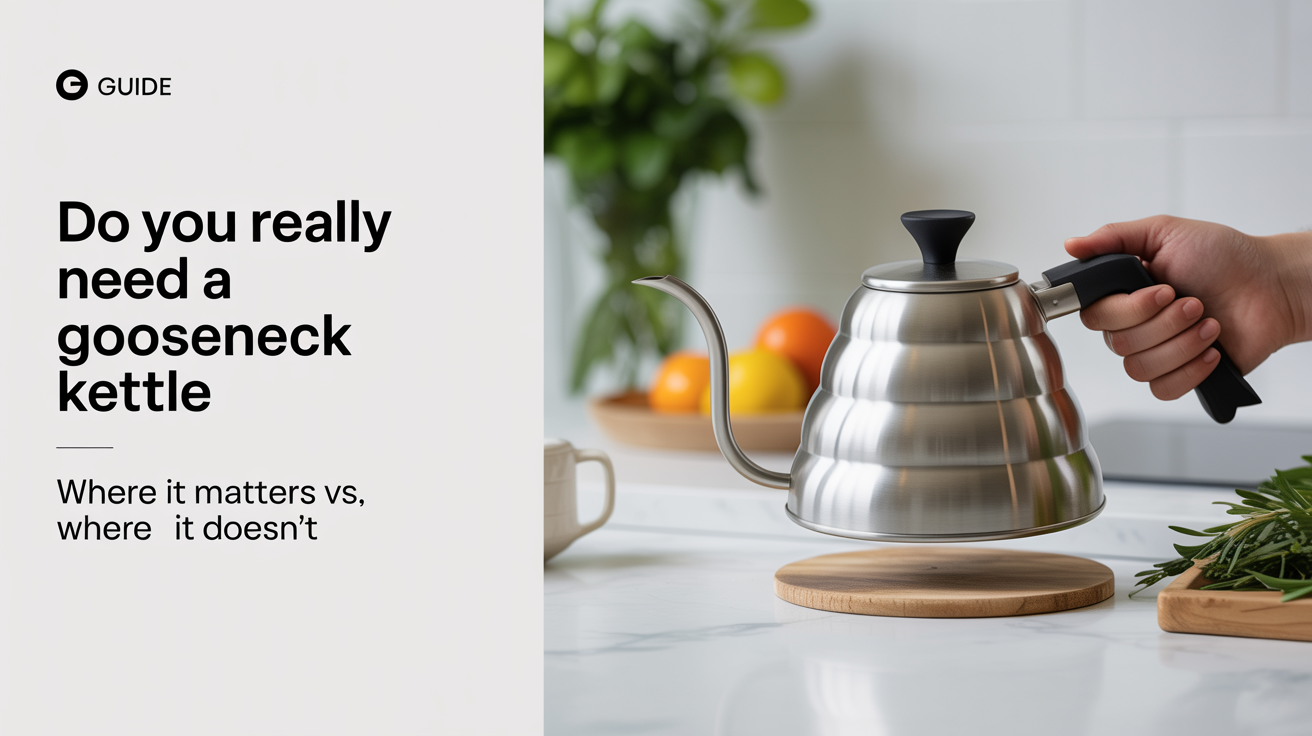
Pour-over methods that benefit a lot: V60, Chemex, Kalita Wave, Origami, most other flat-bed or cone drippers. The entire technique for these brewers is built around pour control. A gooseneck is not optional if you want consistent results.
Methods where it barely matters:
| Brew method | Does flow control help? |
|---|---|
| French press | No. You pour once and stir. |
| AeroPress | Marginal. You can tilt and stir to compensate. |
| Moka pot | No. Water is pushed by steam pressure. |
| Auto drip machine | No. The machine controls the pour. |
| Cold brew | No. No active pouring involved. |
| Siphon | Slightly. Bloom is easier but not critical. |
If V60 is your daily driver, a gooseneck is probably the single biggest upgrade you can make besides dialing in your grinder. If you drink mostly French press, skip it.
Electric vs. stovetop gooseneck kettles
Both work. The choice comes down to what you care about most.
Electric kettles
Electric gooseneck kettles heat water and hold it at a set temperature. That temperature-hold feature is the real selling point, not the electric element itself.
Different coffees extract differently at different temperatures. A light roast Ethiopian might taste thin and sour at 90°C but clean and complex at 96°C. A dark roast often benefits from 88–92°C to avoid bitterness. If you're experimenting with single-origin coffees, a temperature-controlled electric kettle lets you repeat what worked.
Hold time matters too. Most electric models hold temperature for 30–60 minutes. Once you've set 94°C, you can walk away, come back, and pour without checking.
Typical price range: $50–$180. Below $50, the temperature accuracy tends to drift 3–5°C from the display, which undermines the point. The Stagg EKG, Fellow's most popular model, sits around $165 but is often discounted. Bonavita's 1-liter version runs closer to $50–70 and performs well at that price.
Stovetop kettles
A stovetop gooseneck does one thing: control the pour. It won't hold temperature, and you need a separate thermometer or a probe to check the water.
That's a real limitation. Most people who buy stovetop kettles end up using an instant-read probe and boiling, then waiting until the water drops to the target range. It works, but it adds 2–3 minutes to the process every morning.
The upside is durability and simplicity. A good stovetop kettle has no electronics to fail. The Hario Buono has been on the market since the mid-2000s and still holds up. Stovetop models typically run $30–80.
If you pair a stovetop kettle with a digital scale and an instant-read thermometer, you can hit the same precision as an electric model. It's just more manual.
DIY workarounds if you don't want to buy one yet
Before spending money, try these to see if flow control actually improves your coffee:
Tilt slowly from a standard kettle. Keep the spout low to the dripper and pour from just above the grounds. You won't get as thin a stream, but you can slow it down. If your extraction improves, that tells you the gooseneck is worth buying.
Use a ladle or measuring cup. Awkward, but it gets water onto the grounds in small, controlled increments. Good for testing bloom technique without any gear investment.
Pause and pulse. Standard kettles have less control, but short, interrupted pours do give the grounds time to absorb. It's not elegant, but for French press or AeroPress, you'll never notice the difference.
These workarounds reveal something useful: if you try slowing your pour with a regular kettle and taste no difference, you may not need a gooseneck at all. The upgrade only pays off if flow control was actually your limiting factor.
What to look for when buying
If you've decided to buy, here's what actually matters:
Spout diameter. Narrower spouts (around 3–5mm) give the finest stream. Wider ones (6–8mm) are easier to control at higher flow rates without the stream breaking. Most people find 5–6mm easier to learn on.
Counterbalanced handle. A good handle positions the center of gravity so you don't have to muscle the kettle to keep the pour steady. Test the balance in-store if you can.
Capacity. One liter is right for single V60 or Chemex brews. If you often brew for two people or use a large Chemex, look for 1.2–1.5 liters. Smaller 600ml travel kettles exist but require a second fill mid-brew for anything larger than a single cup.
Base width (electric only). Gooseneck kettles are tall and narrow. Make sure the base is wider than the body so it sits stable on the heating element. Some cheaper models tip if bumped.
Material. Stainless steel is the standard. Copper looks nice but transfers heat to the handle faster, which can get uncomfortable. Matte black coatings sometimes chip over time if the kettle hits hard surfaces.
One thing not worth worrying about: brand loyalty. Multiple manufacturers produce good gooseneck kettles. Paying a premium for a name beyond what the specs justify doesn't make the coffee taste different.
Frequently Asked Questions
Can I use a regular kettle for pour-over?
Yes. The coffee won't be undrinkable, but consistency suffers. Without a controlled stream, the bloom is uneven, and the draw-down speed varies pour to pour. If you're serious about pour-over, a gooseneck is the right tool. If you're casual about it, a regular kettle is fine.
What temperature should I use for pour-over?
A common starting range is 90–96°C (194–205°F). Lighter roasts tend to extract better at the higher end; darker roasts at the lower end. If your coffee tastes sour or thin, go hotter. If it tastes bitter or harsh, drop the temperature 2–3 degrees and try again.
Does an expensive kettle make better coffee?
The kettle doesn't improve coffee directly. What you're buying is temperature accuracy, consistent flow control, and ergonomics. A $60 kettle with a well-shaped spout can produce the same cup as a $180 kettle. The expensive ones tend to hold temperature more accurately and have better-balanced handles, which matters if you're brewing daily.
Do I need a thermometer if I have an electric kettle?
Not necessarily. The temperature display on most electric kettles is accurate within 1–2°C, which is close enough. If you want to verify a new kettle's accuracy, an instant-read probe is a useful one-time check.
Is the gooseneck kettle or the grinder more important for pour-over?
The grinder, by a significant margin. Grind consistency directly determines extraction evenness in a way that flow control can only partially compensate for. If you're choosing between upgrading one or the other, read how burr grinders differ from blade grinders first. The gooseneck kettle is the second thing to get right, not the first.