Equipment
Burr vs Blade Grinder: Why It Matters
Burr grinders produce even particle sizes; blade grinders don't. Here's what that difference actually does to your cup, and when it matters most.
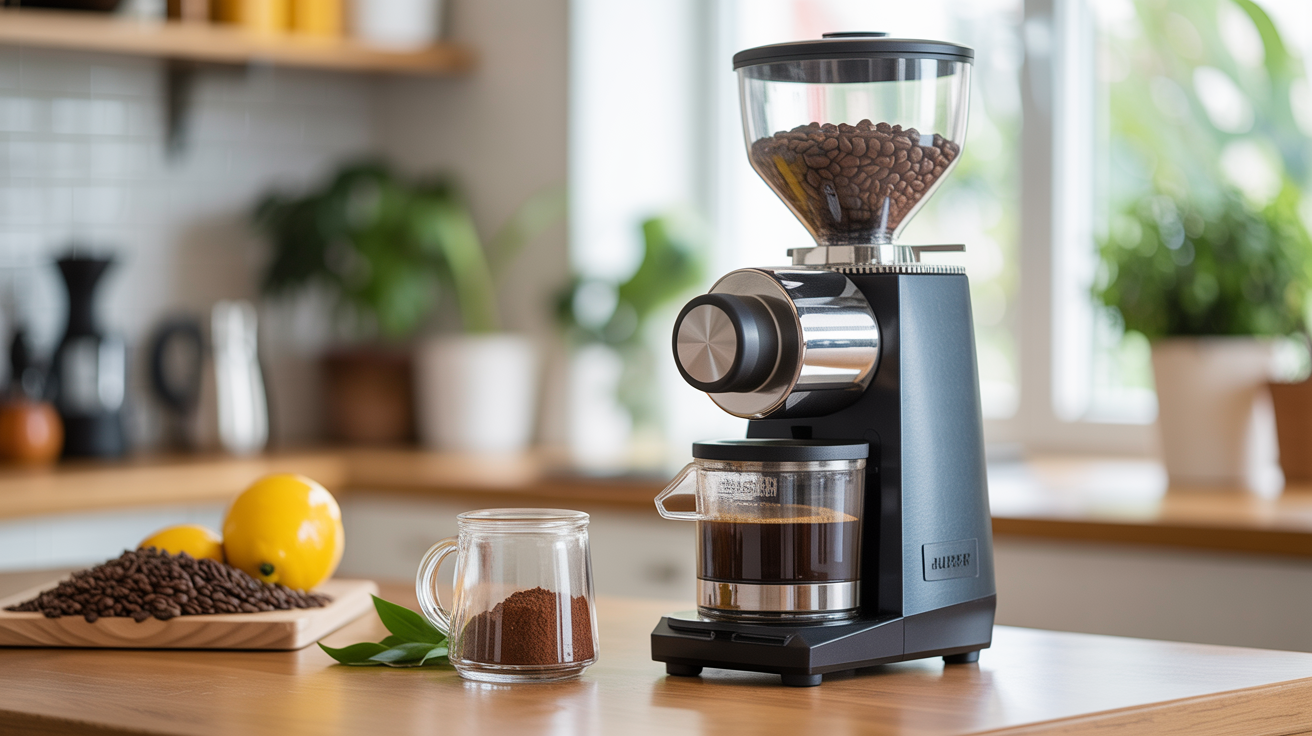
The short answer: a burr grinder crushes coffee between two abrasive surfaces set at a fixed distance, so most particles come out close to the same size. A blade grinder chops beans with a spinning blade, producing a mix of dust and chunks; grinder maker Fellow's breakdown of burr versus blade walks through why that bimodal spread wrecks even extraction. That inconsistency matters because fine particles over-extract (bitter, harsh) while coarse ones under-extract (sour, thin) — and both happen in the same brew.
If you make drip coffee every morning and never think too hard about it, a blade grinder can work. If you're chasing a better cup, a burr grinder is the single most impactful upgrade you can make — more than your kettle, more than your scale.
What a blade grinder actually does
A blade grinder looks like a small food processor. You pulse it until the grounds look fine enough, then stop. The problem is there's no consistent mechanism controlling how fine or coarse the output is. The same 15-second pulse produces different results depending on how much coffee you loaded, how dry the beans are, and how hot the blade got from the last grind.
The fines (tiny dust particles) it produces are the real culprit. They dissolve almost instantly and contribute bitter, astringent compounds. Meanwhile, the larger chunks are still just barely surrendering soluble material. You're tasting both at once, and they don't complement each other.
One quick test: after grinding, look at the pile. If you see a spectrum of sizes from powdery dust to visibly coarse chunks, that's blade grinder output.
When a blade grinder is fine
Cold brew made with coarse-chopped beans in a long steep is more forgiving of uneven particle sizes. If you're making iced coffee in bulk and doing a 12-hour steep, inconsistent grinds matter less than they would in a 3-minute pour-over. A blade grinder also costs $20-$30 new, and for someone who brews a cup occasionally and isn't trying to dial anything in, it does the job.
What a burr grinder does differently
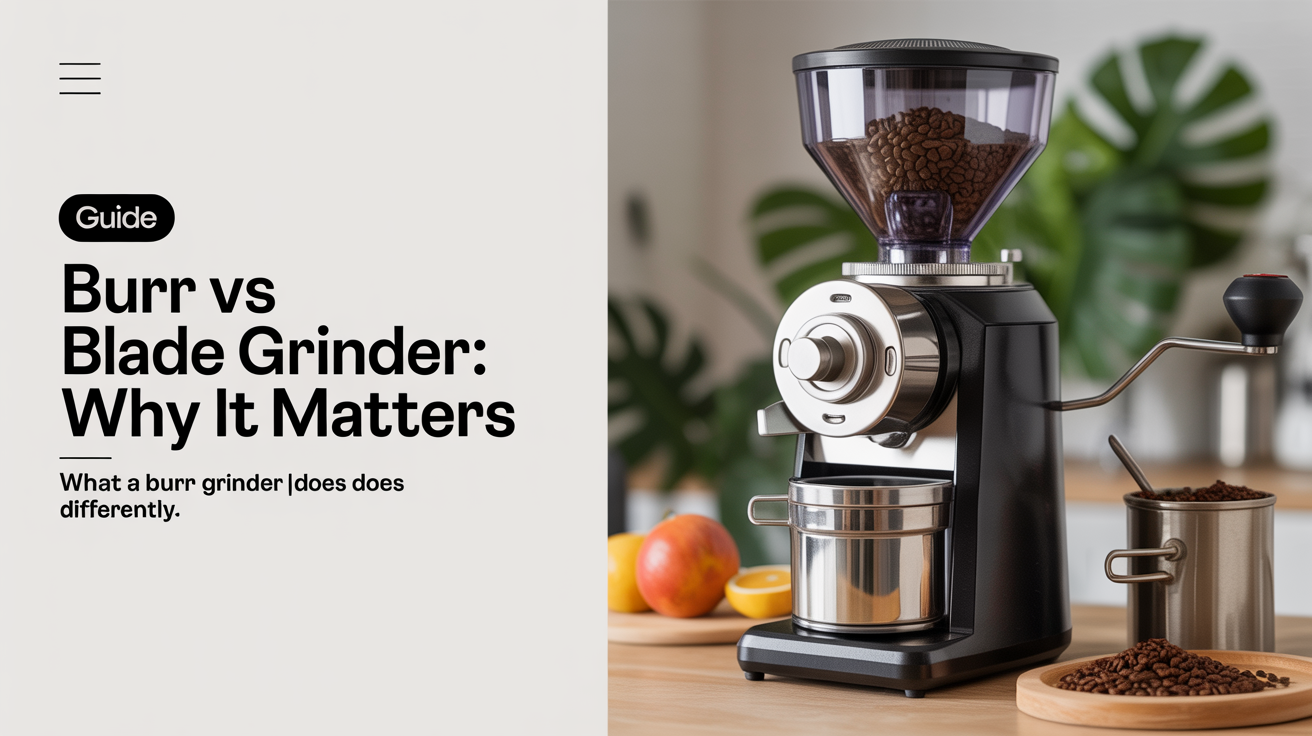
A burr grinder has two abrasive discs (or conical shapes) with a gap between them. Beans fall through the gap and get ground to the size of that gap. Adjust the gap, adjust the grind size. The mechanism is repeatable and doesn't depend on timing or technique.
The grounds coming out are not perfectly uniform, but they're close. The distribution of particle sizes is much tighter, which means most of the coffee hits a similar extraction rate in your brew. The result is cleaner separation of flavors, better sweetness, and less bitterness.
A burr grinder also lets you dial in a specific setting and hit it again tomorrow. That repeatability is underrated. If your pour-over tasted great on Tuesday, you can reproduce it on Wednesday.
Grind size consistency, visualized
| Grinder type | Particle distribution | Adjustable? | Typical price range |
|---|---|---|---|
| Blade grinder | Wide, unpredictable | No | $15-$40 |
| Entry burr (hand) | Moderate, improved | Yes | $30-$80 |
| Entry burr (electric) | Moderate, improved | Yes | $40-$120 |
| Mid-range burr | Tight | Yes | $150-$400 |
| High-end burr | Very tight | Yes | $400+ |
Entry-level burr grinders are a meaningful step up from blade. They're not perfect, but the improvement is audible in the cup.
Conical vs flat burr: does it matter for home use?
This is the next question once you've decided on a burr grinder. Conical burrs are shaped like a cone nested inside a ring; flat burrs are two parallel discs facing each other. Both grind by the same principle.
Flat burrs generally produce a more bimodal distribution (peaks at two particle sizes) and tend to run hotter. They're common in commercial and high-end home espresso machines. Conical burrs produce a single-peaked distribution and run cooler, which some people argue preserves aromatics better.
For home use, the difference is subtle enough that most people won't taste it in a controlled setting. The grinder's overall build quality, burr diameter, and how well it's been calibrated matter more than the burr shape. Don't let conical vs flat burr become the reason you delay buying something.
If you want a deeper comparison of what to look for before buying, the guide on how to choose a coffee grinder walks through RPM, burr diameter, and retention in more detail.
How grind consistency affects different brew methods
Brew method changes how much grind consistency matters. Here's the rough hierarchy:
- Espresso: most sensitive. Fine grind, high pressure, 25-30 second extraction. Even a small shift in particle distribution changes the shot dramatically. A blade grinder is basically unusable for espresso.
- Pour-over: very sensitive. The entire flavor profile of a 3-minute brew depends on even extraction. You'll taste inconsistency clearly.
- AeroPress: moderately sensitive. Shorter contact time and pressure help compensate, but a consistent grind still improves results.
- French press: less sensitive. Coarse grind, long steep, and the full-immersion method forgives a wider particle distribution. A blade grinder at a "coarse" pulse can produce acceptable French press.
- Cold brew: least sensitive. Long steep and cold water slow extraction enough that fines don't ruin the batch.
If you're measuring your dose (a coffee scale makes this much easier to do repeatably), grind consistency starts to matter even more, because you're controlling every other variable and the grinder becomes the remaining source of variation.
Upgrading: what to expect
Switching from a blade to an entry burr grinder is one of the clearest improvements you can make. Most people notice it within a few days of using the same beans with a consistent grind size.
What changes:
- Less bitterness at the same brew ratio
- Cleaner sweetness, especially noticeable in lighter roasts
- More control over strength (adjust dose or ratio, not grind)
- The ability to notice when your beans have gone stale, because good grind consistency removes noise from the equation
The $40-$80 range (hand grinders or entry electrics) is enough to see a real difference. You don't need to spend $200 to notice improvement over a blade. If you're unsure whether a gooseneck kettle is also worth buying at the same time, the comparison at do you really need a gooseneck kettle is worth reading before you spend.
Frequently Asked Questions
Can a blade grinder make good espresso?
Not reliably. Espresso requires a very fine, consistent grind and the ability to adjust by small increments. Blade grinders can't produce that. You'll get uneven extraction, channeling in the puck, and shots that range from sour to bitter with no clear path to improvement. If you're serious about espresso at home, a burr grinder is a requirement, not an upgrade.
Is a hand burr grinder worth it over an electric?
For most people, yes, at the entry level. Hand grinders in the $40-$80 range consistently outperform electric burr grinders at the same price because more of the cost goes into the burrs rather than a motor. The trade-off is time: grinding 18g for espresso takes about 60-90 seconds by hand. If you make more than two cups at a time or grind for French press (larger doses), an electric becomes more practical.
Does burr material matter — ceramic vs steel?
Ceramic burrs are harder and stay sharp longer, but they're brittle and can crack if a small rock gets into your beans. Steel burrs are more durable under impact, sharpen slightly on their own during initial use, and are the standard in most quality grinders. At the price points most home brewers shop, steel burrs are fine. The burr geometry and diameter matter more than the material.
How often do burrs need replacing?
Steel burrs on a home grinder typically last 500-1,000 pounds of coffee before they dull noticeably. At 30g per day, that's 15,000-30,000 days of use, or more than your lifetime. If you're grinding 60-100g daily (multiple household members), they'll need replacement sooner, but still measured in years. Ceramic burrs last even longer in ideal conditions. Replacing burrs is usually $30-$80 for the part, and most quality grinders offer them.
Does pre-grinding coffee ruin it?
Grinding coffee dramatically accelerates staleness because it exposes far more surface area to oxygen. Pre-ground coffee goes noticeably stale within 15-30 minutes in most conditions. This is why grinding fresh matters, and why the grinder is the piece of equipment that directly determines how much of the flavor in your beans makes it into your cup.