Brewing Methods
How to Make Cold Brew Coffee at Home
A practical guide to making cold brew coffee at home: ratios, steep times, equipment options, and how to filter it cleanly.
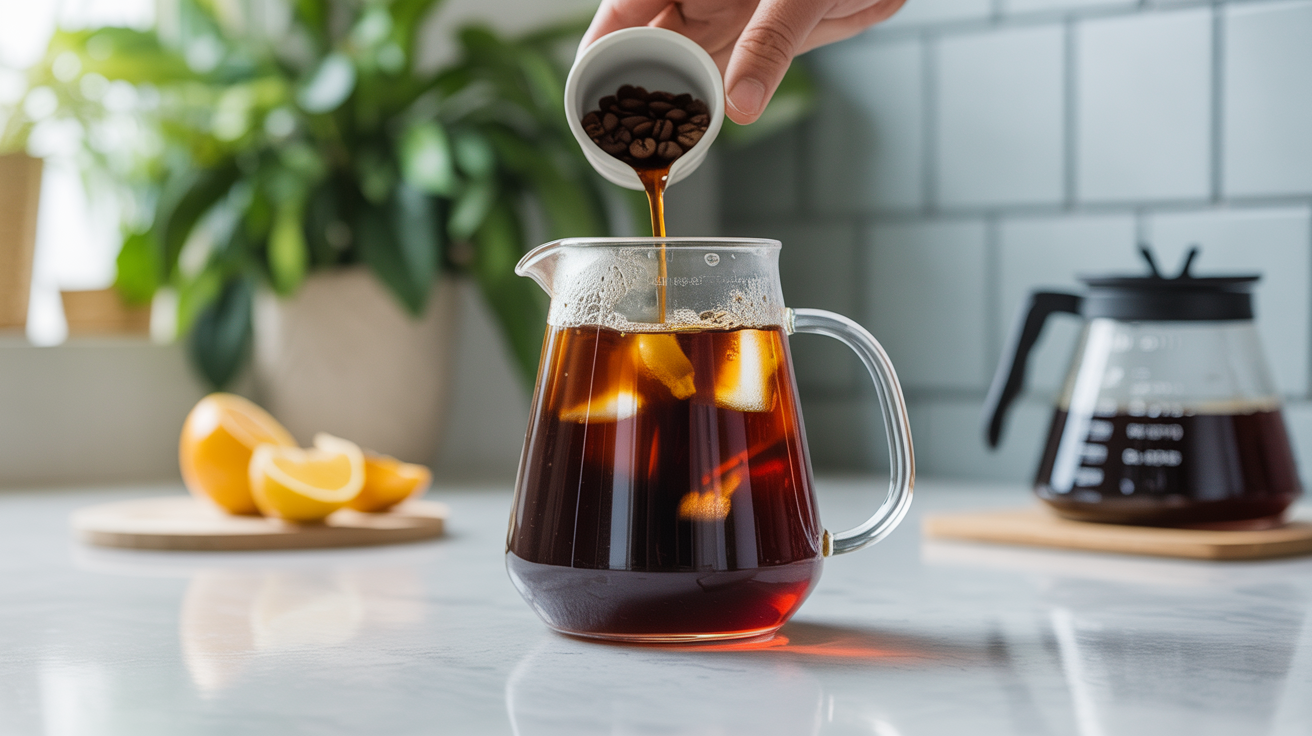
Cold brew is coarse-ground coffee steeped in cold water for 12 to 24 hours, then strained. No heat, no special equipment you don't already own, and the result keeps in the fridge for two weeks. Here's how to do it.
What you actually need
A wide-mouth jar, a kitchen scale, coarse-ground coffee, cold water, and something to filter with. That's the whole list.
Most guides talk about dedicated cold brew makers as if they're required. They're not. A 32-oz mason jar and a fine-mesh strainer get you 90% of the way there. The main thing the fancy pitchers give you is a built-in filter basket, which saves one step at the end.
Equipment options, ranked by cleanup effort:
- Mason jar + cheesecloth or paper filter: most effort to filter, cheapest
- Mason jar + fine-mesh strainer lined with a paper filter: cleaner result, still budget
- French press: built-in plunger does the filtering, easy cleanup
- Dedicated cold brew pitcher (Toddy, OXO, etc.): cleanest output, easiest pour, costs $30-50
The French press method is probably the best entry point if you already own one. Press the grounds down after steeping and pour straight out of the spout.
The ratio: how strong do you want it?
Cold brew ratio is the one variable that trips people up. The confusion comes from conflating ready-to-drink cold brew with concentrate. This guide covers the ready-to-drink version.
For a ready-to-drink cold brew that you pour straight over ice:
| Ratio (coffee:water by weight) | Result | Notes |
|---|---|---|
| 1:4 (e.g. 50g : 200g) | Very strong | Closer to concentrate; dilute before drinking |
| 1:6 (e.g. 50g : 300g) | Strong, ice-friendly | Good starting point |
| 1:8 (e.g. 50g : 400g) | Balanced, medium body | Works well black or with milk |
| 1:10 (e.g. 50g : 500g) | Lighter, mellow | Suits people who find cold brew bitter |
For a 32-oz mason jar, 75g of coffee to 600g (roughly 600ml) of cold water is a solid 1:8 batch. That fills the jar with room for the grounds to expand.
Volume-wise, 1:8 by weight converts roughly to 1 cup of coffee grounds per 4 cups of water, which is the measurement most American recipes use.
Grind size matters more than you'd expect
Use a coarse grind, similar to what you'd use for a French press. The particles should look like coarse sea salt or rough cornmeal, not table salt.
Why coarse? Fine grinds over-extract during a long steep and turn the batch muddy and bitter. They also clog filters.
If you're buying pre-ground coffee specifically for cold brew, look for bags labeled "coarse grind" or "cold brew grind." Otherwise, if you grind at home, set your burr grinder to the coarsest or second-coarsest setting.
One thing to know: the roast level changes the flavor profile noticeably in cold brew. Medium roasts produce a clean, chocolate-forward cup. Light roasts can go fruity and bright, though they sometimes need a longer steep to develop. Dark roasts taste bold and can get a little harsh if steeped past 18 hours. None of those is wrong; it's just worth knowing what you're getting.
How long to steep cold brew
Steep cold brew in the refrigerator for 12 to 24 hours. Steeping on the counter at room temperature cuts that to 8 to 12 hours, but the fridge method produces a smoother, less acidic result.
A few more specific notes:
- 12 hours: light, slightly under-extracted, good for light roasts that you don't want to over-develop
- 16 hours: the sweet spot for most medium roasts; balanced extraction, lower bitterness
- 20-24 hours: stronger extraction, works for dark roasts, or if you like a bolder cup; watch for bitterness creeping in past 22 hours
The grounds stop extracting meaningful flavor once you pull them from the water, so don't rush the filter step once your steep time is done.
Overnight is the real answer
Practically speaking, most people steep overnight and check it in the morning. If you start at 9pm and filter at 9am, you've hit 12 hours. Leave it until noon and you're at 15. Both are fine.
Filtering your cold brew
This is the step that separates a clean, drinkable batch from a gritty one.
If you used a French press: push the plunger down slowly (don't rush it or you'll force fine particles through) and pour directly into a storage container. Done.
If you used a mason jar: set a fine-mesh strainer over a large bowl or pitcher. Line the strainer with a paper coffee filter or a piece of cheesecloth folded twice. Pour the cold brew through slowly. This takes 5 to 15 minutes depending on how much you're filtering. Don't squeeze the cheesecloth; it forces sediment through.
If you used a dedicated cold brew pitcher: follow the manufacturer's instructions; they're all slight variations on a built-in basket removal.
After filtering, transfer to a clean jar or bottle and refrigerate. Cold brew keeps for 10 to 14 days. Taste it at 10 days; if it's starting to taste flat or slightly sour, toss it.
Serving it
Straight over ice is the standard. Use more ice than you think you need; dilution actually smooths out the flavor as the ice melts.
A few other ways to serve it:
- Cold brew with a splash of whole milk or oat milk (the fat cuts any residual bitterness nicely)
- Cold brew over ice with a small pour of sparkling water for a lightly effervescent version
- Blended with ice and milk for a cold brew frappé-style drink
- As the coffee base in an iced latte if you pull a cold brew shot (use the 1:4 ratio for that)
If you want to get into milk-based cold coffee drinks, the AeroPress is worth knowing about too; it produces a cold concentrate that works similarly and can be ready in under two minutes.
Frequently Asked Questions
What's the best coffee to water ratio for cold brew?
1:8 by weight is the most useful general-purpose ratio for ready-to-drink cold brew. That's 50g of coffee per 400g of water, or roughly 1 cup of grounds per 4 cups of water by volume. If you prefer a lighter cup, go to 1:10. If you want it strong enough to stand up to a lot of ice, 1:6 works well.
Can I make cold brew without a special pitcher?
Yes. A mason jar and a fine-mesh strainer lined with a paper filter produces clean, good cold brew. Alternatively, if you own a French press, the built-in plunger handles the filtering step cleanly. A dedicated cold brew pitcher makes the process more convenient but adds nothing to the flavor.
Why does my cold brew taste bitter?
Bitter cold brew usually comes from one of three things: too fine a grind, too long a steep, or using a dark roast past about 18 hours. Start by checking your grind size; it should be coarser than what you'd use for drip coffee. If the grind is right, shorten your steep time by 2 to 4 hours on the next batch.
Do I have to steep cold brew in the fridge?
No, but the fridge produces a better result. Room-temperature steeping is faster (8 to 12 hours versus 12 to 24), but can produce a sharper, more acidic cup because extraction rates are higher at warmer temperatures. If your kitchen is above 75°F / 24°C in summer, stick to the fridge.
How long does cold brew last in the fridge?
About 10 to 14 days. It doesn't go bad suddenly; it just starts losing flavor flatness and can pick up a slightly sour edge. If you're making a big batch, a half-gallon keeps better in a glass jar with a tight lid than in a container that lets in air. Always filter completely before storing; grounds sitting in the cold brew will continue extracting slowly and make it bitter.