Brewing Methods
French Press Coffee, Step by Step
Learn how to brew french press coffee with the right ratio, grind, and steep time. A practical, no-fuss guide for better results at home.
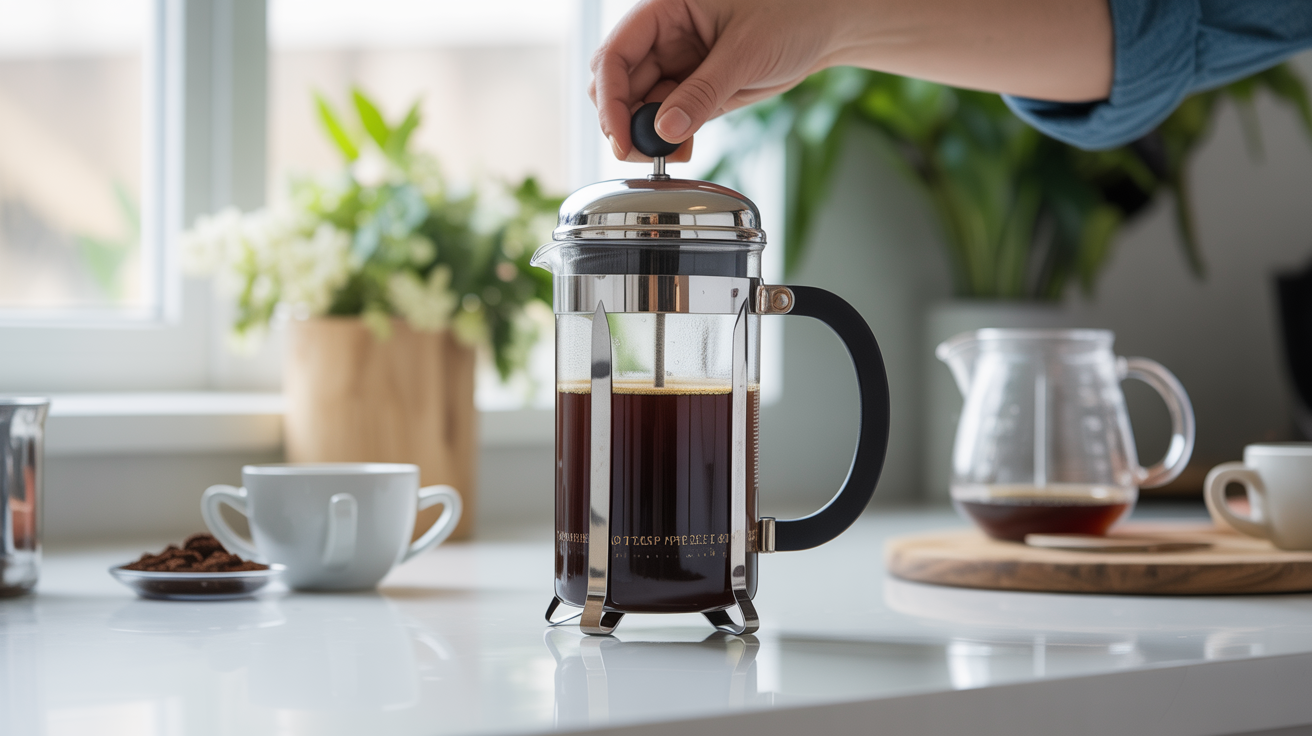
French press coffee is full-bodied, rich, and dead simple to make. You add coarse ground coffee, pour hot water over it, wait four minutes, press, and pour. That's the whole method. The details below help you get it right consistently, rather than discovering what went wrong after the first sip.
What you need before you start
You don't need anything fancy. A French press of any size works, along with a kettle, a scale, a coarse grinder if you have one, and a timer. A thermometer is useful but skippable if you know how to eyeball a boil.
Equipment list:
- French press (any size, glass or stainless)
- Kettle
- Kitchen scale (highly recommended)
- Burr grinder set to coarse
- Timer
- Wooden or plastic spoon (metal scratches glass carafes)
The one thing worth spending money on is a burr grinder. Blade grinders chop coffee unevenly, and uneven grinds mean some particles extract too fast while others barely extract at all. The result tastes muddy and bitter at the same time. A basic burr grinder under $50 fixes this.
The french press ratio
The standard starting point is 1:15 by weight: one gram of coffee for every 15 grams of water. For a 350 ml cup, that's about 23 g of coffee and 350 g of water.
| Press size | Coffee (g) | Water (g) | Water (ml) |
|---|---|---|---|
| 1-cup (12 oz / 350 ml) | 23 g | 350 g | 350 ml |
| 3-cup (12 oz / 350 ml) | 23 g | 350 g | 350 ml |
| 8-cup (34 oz / 1000 ml) | 67 g | 1000 g | 1000 ml |
| 12-cup (51 oz / 1500 ml) | 100 g | 1500 g | 1500 ml |
The 1:15 ratio lands in the middle range, not weak and not overpowering. If you want a stronger cup, move toward 1:12. If it tastes too heavy or chewy, try 1:17. Small adjustments have a noticeable impact, so change the ratio before you start fiddling with grind or time. For more on how ratios affect different brew methods, see the right coffee-to-water ratio for any brew.
Grind size matters more than most people realize
French press needs a coarse grind — about the texture of rough sea salt or breadcrumbs. The mesh filter on a French press doesn't catch fine particles, so they pass through into your cup and keep extracting during the whole time you're drinking. That makes fine grinds taste gritty and bitter.
Coarse grinding gives you clean separation: the big grounds stay below the plunger, the liquid stays above it. If you're using a burr grinder, set it to the coarsest or second-coarsest setting as your starting point, then adjust based on taste.
Pre-ground coffee sold as "French press" or "coarse" can work in a pinch. It's inconsistent between brands, but decent coffee ground fresh at a grocery store's grinder (set to French press) gets you close.
Step-by-step brew instructions
This takes about five minutes of active time and requires no special skill once you've done it twice.
1. Preheat the press
Pour hot water into the empty carafe and let it sit for 30 seconds, then discard. This keeps the brew temperature stable and avoids the first 20 degrees of heat disappearing into cold glass.
2. Add your grounds
Add your measured coffee to the empty, preheated carafe. Set the carafe on the scale and tare it to zero so you can measure water directly.
3. Pour and saturate
Water temperature should be 195-205°F (90-96°C), the same 93±3°C band the National Coffee Association recommends for French press. If you don't have a thermometer, bring water to a full boil and let it sit off heat for 30-45 seconds. Pour just enough water to saturate all the grounds, roughly twice the weight of the coffee. Wait 30 seconds. This initial bloom lets CO2 escape from freshly roasted coffee and helps even extraction.
4. Fill and stir
Pour the remaining water in slowly to reach your target weight. Give it a gentle stir to make sure all the grounds are wet and none are floating dry on top.
5. Place the lid and steep
Put the lid on with the plunger pulled up. Set your timer for 4 minutes. Don't press yet.
6. Press slowly
When the timer goes off, press the plunger down with steady, slow pressure over about 20-30 seconds. If it plunges easily in 5 seconds, your grind is too coarse. If it's nearly impossible to push, it's too fine. Aim for moderate, consistent resistance.
7. Pour immediately
Pour the coffee into your cup as soon as you've pressed. Leaving brewed coffee sitting on the grounds over-extracts and turns it bitter. If you're not drinking it all at once, pour the whole batch into a thermos or separate vessel.
French press steep time
Four minutes is the standard steep time for French press, and it works well for most coffees at a coarse grind. That said, it's not a fixed rule.
- 3 minutes: Lighter, brighter cup. Good for light roasts where you want more acidity and less body.
- 4 minutes: The reliable middle ground. Works for most coffees.
- 5 minutes: Fuller body, more pronounced bitterness. Can work for darker roasts; risky with anything medium or lighter.
If your coffee tastes sour or thin, try a slightly finer grind or 30 more seconds of steep time. If it tastes bitter or dry, go coarser or cut 30 seconds. Change one variable at a time so you know what actually made the difference.
Common problems and how to fix them
Gritty texture in the cup. Grind is too fine. Coarsen it up, and make sure you're pressing all the way down and pouring clean.
Weak, watery coffee. Either the ratio is off (too little coffee), the grind is too coarse, or the steep time is too short. Start by checking your ratio against the table above.
Bitter, harsh taste. Usually over-extraction: too fine a grind, too long a steep, or water that was too hot. Let boiled water rest a full minute before pouring.
Plunger hard to press. Grind is too fine. It'll also produce more sediment in the cup.
Grounds floating on top after steeping. You didn't stir after adding water, or the grind is very coarse. Either is fine — just skim the floating crust before pressing, or stir it in right after pouring.
The French press rewards a bit of attention but forgives small mistakes better than methods like pour over coffee, where grind size and pour rate interact in tighter ways.
Frequently Asked Questions
How long should you steep french press coffee?
Four minutes is the standard. For light roasts, three minutes often works better and keeps the cup from getting too heavy. For dark roasts going for maximum body, five minutes is the upper limit before bitterness becomes the dominant note. The grind size and steep time work together, so if you adjust one, you may need to adjust the other.
What is the best french press ratio?
Start with 1:15 (1 g coffee per 15 g water). For a typical 8-cup press holding about 1000 ml, that's 67 g of coffee. Adjust from there based on taste: stronger means moving toward 1:12, milder means moving toward 1:17. Measuring by weight rather than scoops gives you consistent results every time.
Can you use regular ground coffee in a french press?
Yes, but standard pre-ground coffee is usually medium grind, which is finer than ideal for French press. It'll produce a murkier cup with more sediment and some bitterness. If that's what you have, use it. Just shorten the steep time to 3 minutes and press slowly. Buying whole beans and grinding coarse makes a noticeable difference.
Why does my french press coffee taste bitter?
Bitterness usually means over-extraction: too fine a grind, too long a steep, or water that was too hot (over 205°F). Try coarsening the grind first. If that doesn't fix it, check your water temperature. A full minute off boil gets you into the right zone without a thermometer.
How does french press compare to aeropress?
French press gives you a heavy, full-bodied cup with some natural sediment in it. The metal mesh filter lets oils through, which is part of the flavor. Aeropress uses paper or metal filters and steeps under pressure, producing a cleaner, more concentrated cup with more flexibility over variables. If you want to experiment further with pressure and different recipes, aeropress techniques are worth trying alongside French press to see what suits your taste.
Do you need to preheat the french press?
You don't have to, but it helps. Cold glass drops your brew temperature by 10-15 degrees in the first minute, which affects extraction and means the first cup of the morning is never quite as good as it could be. A 30-second rinse with hot tap water is enough.