Coffee Recipes
Homemade Cold Brew Concentrate
Make cold brew concentrate at home with a 1:4 coffee-to-water ratio. Steep 12–24 hours, strain, dilute 1:1 with water or milk, and drink all week.
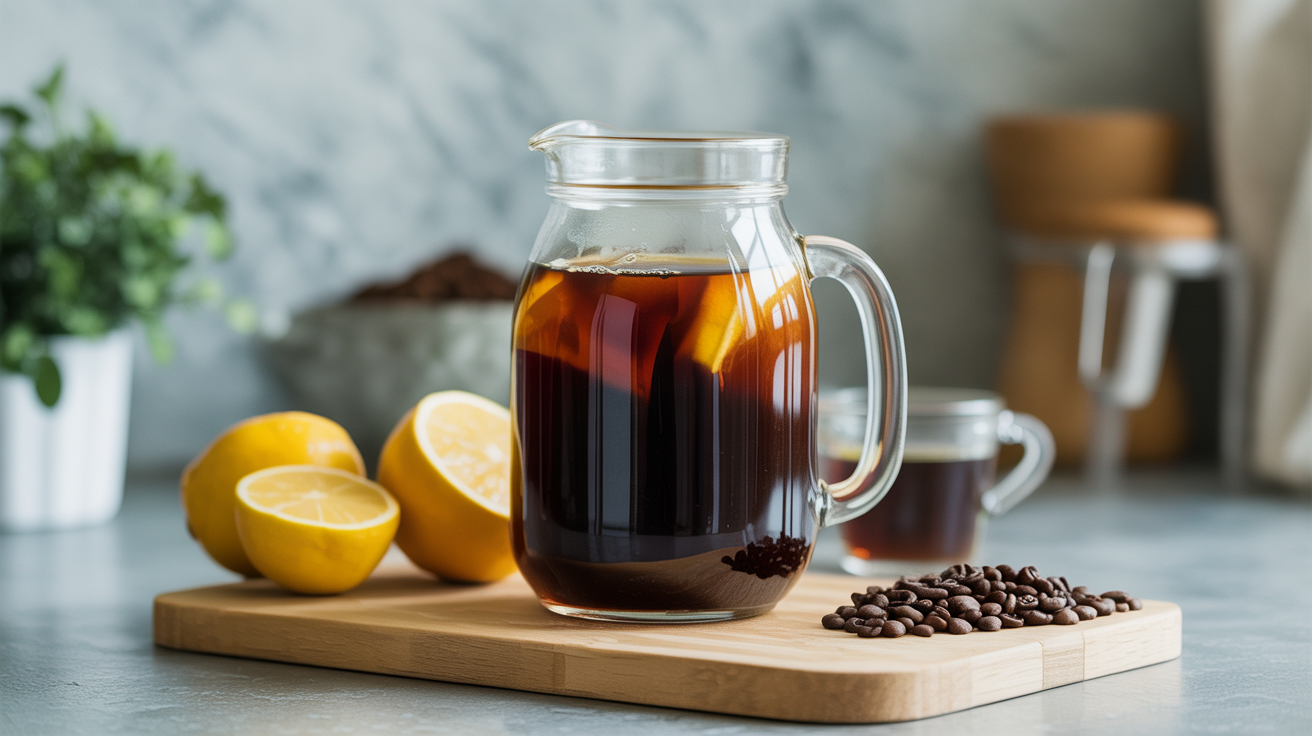
Cold brew concentrate is just cold brew made with more coffee than usual, enough that you dilute it before drinking. A 1:4 ratio of coffee to water (by weight) gives you a concentrate that you cut 1:1 with water or milk at serving time. Steep overnight, strain in the morning, and you have a week's worth of cold coffee in the fridge. That's the whole method.
At a Glance
- Standard concentrate ratio: 1:4 coffee to water by weight, diluted 1:1 at serving time.
- Steep 12 hours at room temperature or 18 to 24 hours in the fridge; don't go past 24 hours.
- Grind coarse, like French press. Finer grounds turn bitter over a long steep and clog paper filters.
- A double-strain (mesh strainer, then paper filter) is what separates clean concentrate from muddy, short-lived concentrate.
- Properly made and stored, concentrate keeps about two weeks refrigerated.
- One 750 ml batch of concentrate makes roughly 1.5 liters of finished, ready-to-drink cold brew once diluted.
What makes it a concentrate
Standard cold brew runs around 1:8 coffee to water. That's ready to drink straight. Concentrate uses twice as much coffee, 1:4, so the final brew is too strong on its own, but perfect after dilution.
The payoff is storage. One batch of concentrate (say, 750 ml) becomes roughly 1.5 liters of finished cold brew once you dilute it. It stores longer than pre-diluted cold brew because it's denser and there's less water for bacteria to work with; refrigerated, it stays good for two weeks. That said, "two weeks" assumes a clean jar and a lid that actually seals; a loosely covered container in a fridge that opens and closes all day won't hold the same timeline.
Some people go even stronger, down to 1:3 or even 1:2. At 1:2 you're essentially making a coffee syrup, which is useful for mixing into cocktails or baking, but it's easy to over-extract into bitterness if you push the steep time past 16 hours.
What you need
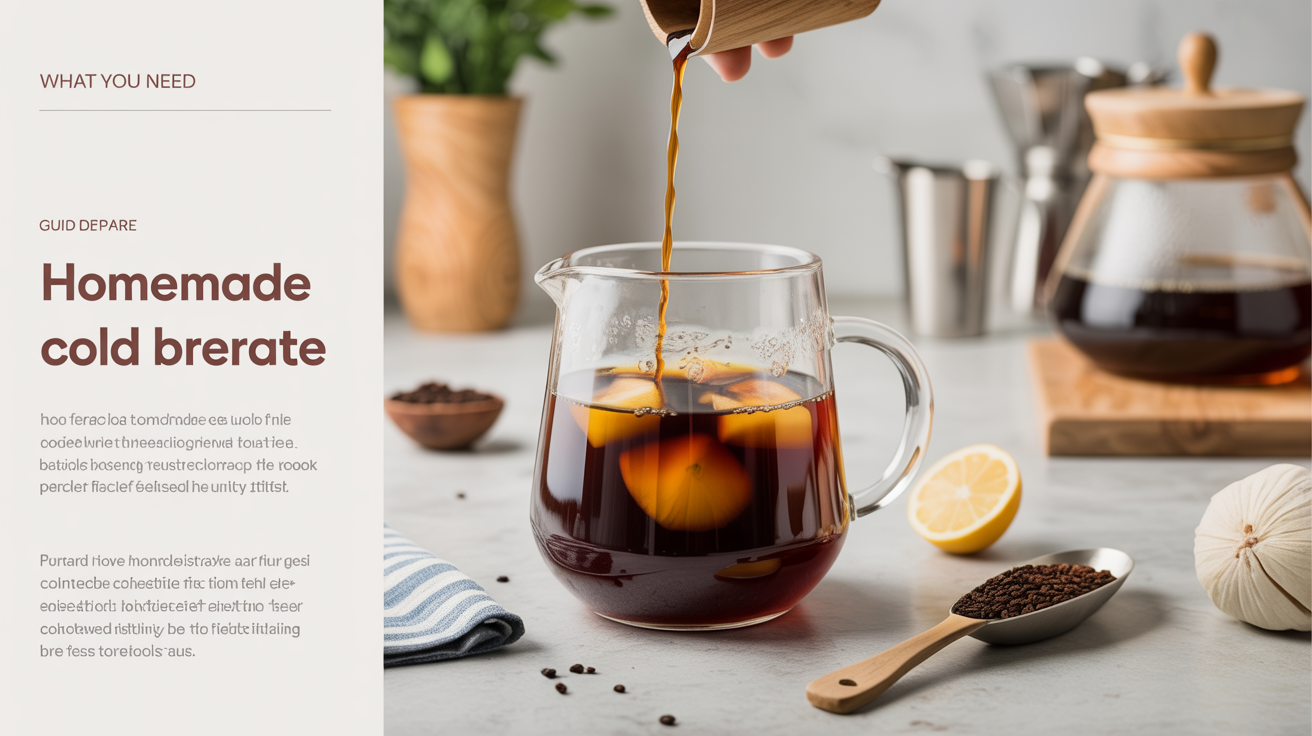
- Coarse ground coffee: 200 g
- Cold or room-temperature filtered water: 800 ml
- A large jar or pitcher: 1.5 liters or bigger
- A fine mesh strainer plus a paper filter or cheesecloth
- Scale (volume measurements are imprecise for coffee)
For grind size: think French press coarse, or one notch coarser than that. Finer grounds pull bitter notes more quickly during a long cold steep, and they clog paper filters badly.
For the coffee itself: medium to dark roasts tend to taste better as concentrate. Not because cold brew can't work with light roasts, but because the fruity, bright notes in many light roasts get muted by long cold steeping. Medium roasts with chocolate or caramel notes come through cleanly. If you like a light roast in your pour-over, try it in a shorter cold brew steep (12 hours vs 24) before committing a full batch.
The cold brew concentrate ratio
The standard concentrate ratio is 1:4 coffee to water by weight, the low end of the 1:4 to 1:5 range the National Coffee Association gives for cold brew. Here's how different ratios behave:
| Ratio (coffee:water) | Use case | Dilution at serving | Approx. yield from 200g coffee |
|---|---|---|---|
| 1:2 | Cocktails, desserts | 1:3 or more | 400 ml concentrate |
| 1:3 | Strong concentrate | 1:1 with water/milk | 600 ml concentrate |
| 1:4 | Standard concentrate | 1:1 with water or milk | 800 ml concentrate |
| 1:5 | Mild concentrate | Slight dilution or straight | 1000 ml concentrate |
| 1:8 | Ready-to-drink cold brew | None | 1600 ml finished coffee |
Starting at 1:4 is the right call for most home brewers. You can always add water; you can't un-steep an over-extracted batch.
How to make cold brew concentrate
1. Weigh and grind
Weigh 200 g of coffee and grind it coarse. If you don't have a scale, that's roughly 2 heaping cups of whole beans, but buy a cheap kitchen scale; imprecision here is where batches go wrong.
2. Combine coffee and water
Put the grounds in a 1.5-liter jar or pitcher. Pour 800 ml of filtered water over them. Cold tap water or room-temperature water both work; room temperature incorporates slightly faster. Stir to saturate all the grounds, then cover loosely.
3. Steep
Leave it on the counter for 12 hours, or in the fridge for 18 to 24 hours. Counter-steeping is faster because room temperature accelerates extraction. Fridge-steeping is slower but produces a slightly cleaner, less astringent result.
Don't go past 24 hours at room temperature. Past that, you're pulling out compounds that make the concentrate harsh and dry.
4. Strain
Set a fine mesh strainer over a large bowl or second pitcher. Pour the steep slowly through the strainer to catch the grounds. Then line the strainer with a paper coffee filter (or a few layers of cheesecloth) and pour the strained coffee through that. This second pass removes the fine sediment that makes the concentrate muddy and shortens its fridge life.
The straining step takes patience; don't press the grounds to speed it up, or you'll push bitter silt through.
5. Store
Pour the finished concentrate into a clean jar or bottle with a lid. Refrigerate immediately. Label it with the date.
How to dilute the concentrate
The baseline is 1 part concentrate to 1 part water or milk. Fill a glass with ice, add 120 ml (4 oz) concentrate, then top with 120 ml water, cold brew oat milk, or whatever you're using.
From there:
- Stronger: 2 parts concentrate to 1 part water
- Milder: 1 part concentrate to 2 parts water
- Iced latte: 1 part concentrate, 2 parts cold milk (the milk reads creamier when it's not 1:1 with a strong concentrate)
- Hot coffee: Dilute the concentrate with hot water instead of cold. It dissolves cleanly and you don't lose the cold brew taste profile
If you want to use this as the base for a homemade iced latte, treat the concentrate the way you'd treat a shot of espresso: pour over ice, then milk. The concentrate is strong enough that you don't need to pull actual espresso to get close to that flavor.
Common problems
Bitter concentrate: Usually over-steeped or ground too fine. Try 12 hours instead of 24, or go coarser on the grind.
Weak concentrate: Ground too coarse, or water wasn't filtered and there's chlorine interfering with extraction. Also check your ratio; scooping coffee by volume rather than weight leads to under-dosing pretty consistently.
Cloudy or gritty concentrate: Skipped the paper filter step. Strain again through a paper filter. The cloudiness is fine silt that settles and doesn't affect flavor much, but it shortens fridge life and looks unappetizing.
Concentrate went bad before two weeks: Either the jar wasn't clean, or you double-dipped into it with something wet. Always pour it out; don't dip a spoon in.
Using concentrate beyond iced coffee
This is where having a concentrate in the fridge starts to feel more useful than buying cold brew bottles. A few things that actually work:
Whipped coffee with concentrate: The dalgona method traditionally uses instant coffee, but you can dissolve 2 tablespoons of your concentrate with 2 tablespoons of sugar and whip it. It doesn't foam the same way but makes a thick coffee cream that works over ice.
Cold brew cortado: Equal parts concentrate and whole milk, no ice, in a small glass. It sits somewhere between a cortado and a cold brew, not as thick as a cortado, not as diluted as an iced latte. Worth trying if you have leftover concentrate and don't want another tall glass.
Coffee ice cubes: Freeze the concentrate in ice cube trays. Add them to iced coffee or an iced latte and the cubes melt into more coffee instead of watering it down.
Marinade: Sounds odd, but 60 ml of concentrate in a beef or pork marinade adds depth without a strong coffee flavor.
A worked example: batch size for a week of drinking
If you drink one 12-ounce iced coffee a day, work backward from that to size your batch instead of guessing.
| Daily servings | Diluted coffee needed per week | Concentrate needed (at 1:1 dilution) | Coffee to weigh out |
|---|---|---|---|
| 1 (12 oz) | ~2.5 liters | ~1.25 liters | ~310 g coffee / 1250 ml water |
| 2 (12 oz each) | ~5 liters | ~2.5 liters | ~625 g coffee / 2500 ml water |
These numbers scale directly off the 1:4 ratio (200 g coffee to 800 ml water makes 800 ml concentrate, which becomes 1.6 liters diluted). If your pitcher or jar can't hold the full batch, split it across two containers rather than under-filling one and getting inconsistent extraction from uneven grounds-to-water contact.
Frequently Asked Questions
How long does cold brew concentrate last in the fridge?
Two weeks is the standard answer, and it's accurate for a properly made batch stored in a clean sealed jar. Past two weeks, the flavor degrades even if it hasn't spoiled. If it smells sour or fermented, toss it regardless of the date.
Can I make cold brew concentrate without a scale?
You can approximate with volume: for 1:4 by weight, use 1 cup of ground coffee to 4 cups of water. The problem is that coffee density varies; a cup of finely ground coffee weighs more than a cup of coarse-ground. A basic kitchen scale solves this for under $15.
What coffee grind size should I use for concentrate?
Coarse, like French press. Finer than that and you'll over-extract during the long steep, and paper filtering becomes very slow.
Does cold brew concentrate have more caffeine than regular cold brew?
Per milliliter, yes; it's more concentrated. But after you dilute it 1:1, the caffeine in your finished drink is similar to regular cold brew. For context, a standard 8-ounce cup of brewed coffee runs about 95 mg of caffeine, and a 4 oz pour of undiluted concentrate will land well above that. If you drink it without diluting, or dilute less than 1:1, you're getting noticeably more caffeine per glass.
Can I use warm or hot water to make the concentrate faster?
You can make cold brew with room-temperature water, which is a bit faster than cold, but using hot water changes the extraction chemistry and produces hot brew coffee, not cold brew. It's a different product, more acidic and less sweet. If you want something fast, just make strong hot coffee and cool it over ice (though it won't taste the same).
Can I reuse the coffee grounds for a second batch?
Not really worth it. Most of the soluble compounds that give coffee its flavor and caffeine come out in the first steep, so a second pass with the same grounds produces something thin and mostly flat-tasting rather than a genuinely weaker version of the same coffee. If you're trying to stretch a batch further, it's more reliable to just use slightly less coffee on the next batch and accept a milder concentrate than to double up a spent batch of grounds.
Should I steep on the counter or in the fridge?
Counter-steeping at 12 hours is faster and extracts more per hour, since warmer temperatures speed up extraction. Fridge-steeping at 18 to 24 hours is slower but tends to taste cleaner, with less of the sharp, slightly vegetal edge that a fast room-temperature steep can leave in some beans. If your kitchen regularly runs warm, above about 75°F, lean toward the fridge method so you don't accidentally over-extract before the 12-hour mark. If you're in a cooler space or want the batch ready by morning after a late-night start, the counter method is the more forgiving default.
Can I make a smaller batch to test a new bag of beans before committing?
Yes, and it's a good habit before you steep a full 800 ml batch with an unfamiliar coffee. Scale everything down proportionally, for example 50 g coffee to 200 ml water for a quarter batch, and steep in a jar or even a large mason jar. You'll get a smaller yield, but the ratio and steep time behave identically at any scale, so what you taste in a test batch is a reliable preview of the full one.