Equipment
Types of Espresso Machines, Explained
A guide to types of espresso machines, from manual lever to super-automatic, with the key trade-offs you need before buying.
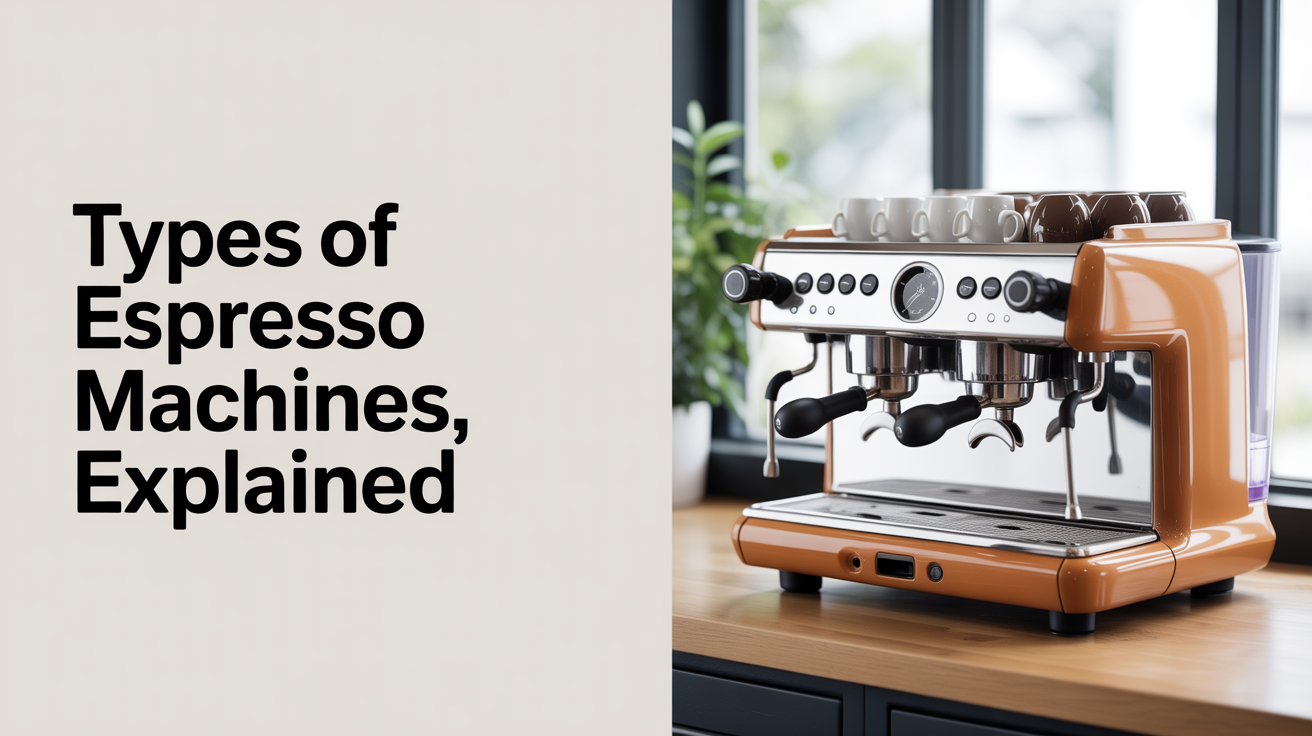
The most common question before buying an espresso setup is not which machine costs the most. It is which machine type fits how you actually want to brew. Manual lever, semi-automatic, fully automatic, super-automatic, capsule. These are not just marketing labels; each one describes a different mechanical approach to building 9 bars of pressure and forcing hot water through a puck of ground coffee. The category you choose determines what you do at the machine, not just what the machine does for you.
Manual Lever Espresso Machines
A lever machine generates pressure the old way: you do. Pulling a lever either compresses a spring (spring-lever) or pushes water directly through the puck by hand (direct-lever). Neither type uses a pump.
The experience of pulling a manual lever shot is unlike any other. You feel the resistance of the coffee, sense when the puck is channeling, and adjust pressure through the arc of the pull. That tactile feedback is the appeal. Shots on a spring-lever machine produce a classic pressure profile: it rises as the spring loads, peaks around 8 to 9 bar, then tapers as the spring relaxes. The taper at the end gives lever shots a softer, more rounded finish compared to pump-machine espresso.
Spring-Lever vs. Direct-Lever
Spring-lever machines require you to lift the lever to load the spring, then release. The spring does the work from there. Direct-lever machines require you to hold the lever through the entire pull, sustaining pressure manually. Both types can produce excellent espresso; the spring-lever is more consistent for beginners because the pressure profile is built into the mechanism rather than your arms.
The main trade-off: these machines have no pump, which means fewer motorized components to fail. They also have no electronic pressure control, which means the learning curve is steeper. Temperature stability is critical on lever machines, so models with a large thermal mass (brass or copper grouphead, generous boiler size) tend to outperform compact ones.
Semi-Automatic Espresso Machines
This is the type most home espresso hobbyists end up with. A semi-automatic machine has an electric pump that builds and maintains pressure, usually around 9 bar, and a grouphead that delivers water at a target extraction temperature between 195°F and 205°F (90°C to 96°C). What you control: grinding, dosing, tamping, and starting and stopping the shot. What the machine handles: pressure and boiler temperature.
The word "semi-automatic" can be misleading. On most of these machines, you press a brew button to start water flow and press it again to stop. That is it. The rest is preparation: the dose (typically 18 g to 20 g for a double), the grind size, and the tamp pressure (about 30 lbs or 130 N is common). The machine cannot compensate for a bad grind or an uneven tamp, which is why choosing the right grinder matters as much as the machine itself.
Boiler Types in Semi-Automatics
Single boiler machines use one boiler for both brewing and steaming. You brew, then switch the boiler to a higher steam temperature (around 255°F or 124°C) before texturing milk. Waiting for that switch takes 30 to 90 seconds depending on the machine. This is inconvenient if you make a lot of milk drinks but workable for black espresso.
Dual boiler machines keep two separate boilers, one for brewing and one for steam, so both are ready at the same time. Heat exchanger machines (often called HX machines) use a single boiler with an internal coil that heats brew water separately from the steam reservoir. HX machines typically cost less than dual boilers and perform well for home use, though managing the brew temperature requires a bit more attention.
Automatic Espresso Machines
Automatic espresso machines look similar to semi-automatics but add volumetric dosing. You program a shot volume (say, 36 ml for a double), and the machine cuts water flow automatically when that volume is reached. You still grind, dose, and tamp by hand.
This matters for consistency. If you pull ten shots a day, not having to manually stop each one removes one variable. The downside: volumetric dosing measures water volume, not extraction quality. A shot that flows too fast will hit 36 ml before the coffee extracts properly. Volume-based repeatability only works if your grind and dose are already dialed in first.
Super-Automatic Espresso Machines
Super-automatics handle the entire process: grinding, dosing, tamping, and brewing, often in a single button press. Load beans, add water, press a button, and espresso comes out. These machines include a built-in burr grinder and an automated tamping or puck-pressing mechanism.
The trade-off is control. You can usually adjust grind coarseness and brew strength within a set range, but that range is narrower than what you get with a dedicated grinder paired to a separate machine. Built-in grinders in super-automatics are generally adequate rather than excellent, and burr wear in an integrated unit affects the machine's overall maintenance schedule.
Super-automatics work well for households where multiple people want espresso with minimal friction, or for offices. For someone who wants to learn espresso as a craft, they remove most of the variables that make that learning meaningful.
Capsule and Pod Machines
Capsule machines pre-package the coffee for you: dose, grind, and tamping are fixed inside the capsule. The machine punctures it, forces water through at pressure, and delivers the shot. Cleanup takes seconds.
Brew pressure on capsule machines varies by system. Some run at 15 to 19 bar (with internal flow restriction bringing effective extraction pressure lower), while others operate around 9 bar. Shot quality depends heavily on the capsule coffee itself. Because you cannot grind fresh or adjust the dose, the ceiling on what these machines can produce is lower than any of the types above.
Capsule machines solve a real problem: they make a consistent espresso-style drink with no skill required. The ongoing cost of capsules adds up compared to buying whole beans, and proprietary pod formats tie you to one brand's selection.
Matching the Machine to Your Situation
A few practical notes for narrowing the choice.
If you want to learn espresso and enjoy the process of developing skill, a semi-automatic is the right starting point. The machine handles pressure; you handle preparation. Most people who get serious about espresso own a semi-automatic at some point.
If you want maximum control and do not mind a steep learning curve, a lever machine is the logical direction. The grinder still matters enormously. A burr grinder capable of fine, stepless adjustment is a prerequisite regardless of machine type. The difference between burr and blade grinders has a direct effect on extraction quality, and no machine changes that.
If consistency with minimal involvement is the priority, an automatic or super-automatic fits better than a semi-automatic. You trade hands-on involvement for repeatable output.
Budget shapes the decision, too. Decent semi-automatics start around $300 to $400. Entry-level lever machines are in a similar range, though well-regarded ones often sit higher. Super-automatics span from around $400 to well over $2,000 depending on build quality, grinder type, and features like an integrated milk system.
One thing worth noting across all these categories: the machine does not pull the shot alone. Preparation, grind consistency, water temperature, and dose all feed into the cup. Buying the most expensive machine without a quality grinder produces worse espresso than a modest semi-automatic paired with a good burr grinder.
Frequently Asked Questions
What is the difference between a semi-automatic and an automatic espresso machine?
A semi-automatic machine requires you to stop the shot manually by pressing the brew button again. An automatic machine cuts water flow on its own once it reaches a pre-programmed volume. Both types require you to grind, dose, and tamp by hand; the difference is only in how the shot ends.
Do I need a manual lever machine to pull a good shot?
No. Lever machines offer a distinctive pressure profile and a tactile brewing experience, but excellent espresso also comes out of well-dialed semi-automatics. The grinder and preparation technique affect the shot more than whether the machine uses a pump or a spring.
Are capsule machines considered real espresso?
They produce a concentrated, crema-bearing coffee drink that resembles espresso in texture and volume. The extraction parameters on many capsule systems differ from traditional pump espresso at 9 bar, but for everyday drinking, the result is close enough that most people will not notice a meaningful difference.
What espresso machine type is best for beginners?
A single-boiler semi-automatic is the most common starting point. The machine handles pressure and temperature while you develop grinding and tamping technique. Pairing it with a quality burr grinder gives you a setup you can improve on as your skill builds.
Can I froth milk on all espresso machine types?
Most semi-automatics, automatics, and lever machines include a steam wand. Some capsule systems have frothing attachments or a separate steam function. Super-automatics often include an automatic milk frothing system built into the housing. Steam quality and temperature vary by boiler type and machine design.